PROJECT OVERVIEW
HonorHealth's 4,000+ physicians and APPs were flying blind.
Despite strong email performance, providers couldn't find information when they actually needed it. Content was scattered, the existing physician site was virtually unknown, and there was no strategy holding any of it together.
I built the communications and UX strategy from the ground up. I defined audience segments, reduced 15 content categories to five, conducted a 335-person survey and 13 interviews, ran a card sort to validate the information architecture, and designed two iterations of a high-fidelity website now in active development.
Role
Lead designer and strategist
Status
In development (Q2 2026 launch)
Tools
Figma, Photoshop, UXtweak, Miro
Impact
Contributed to a Balanced Scorecard (the primary metric used by leadership to track system-wide success) goal, moving engagement scores from 3.8 to 3.95 (approaching the 4.0 target)
The problem
Providers didn't know where to go or how to find what they needed when it mattered.
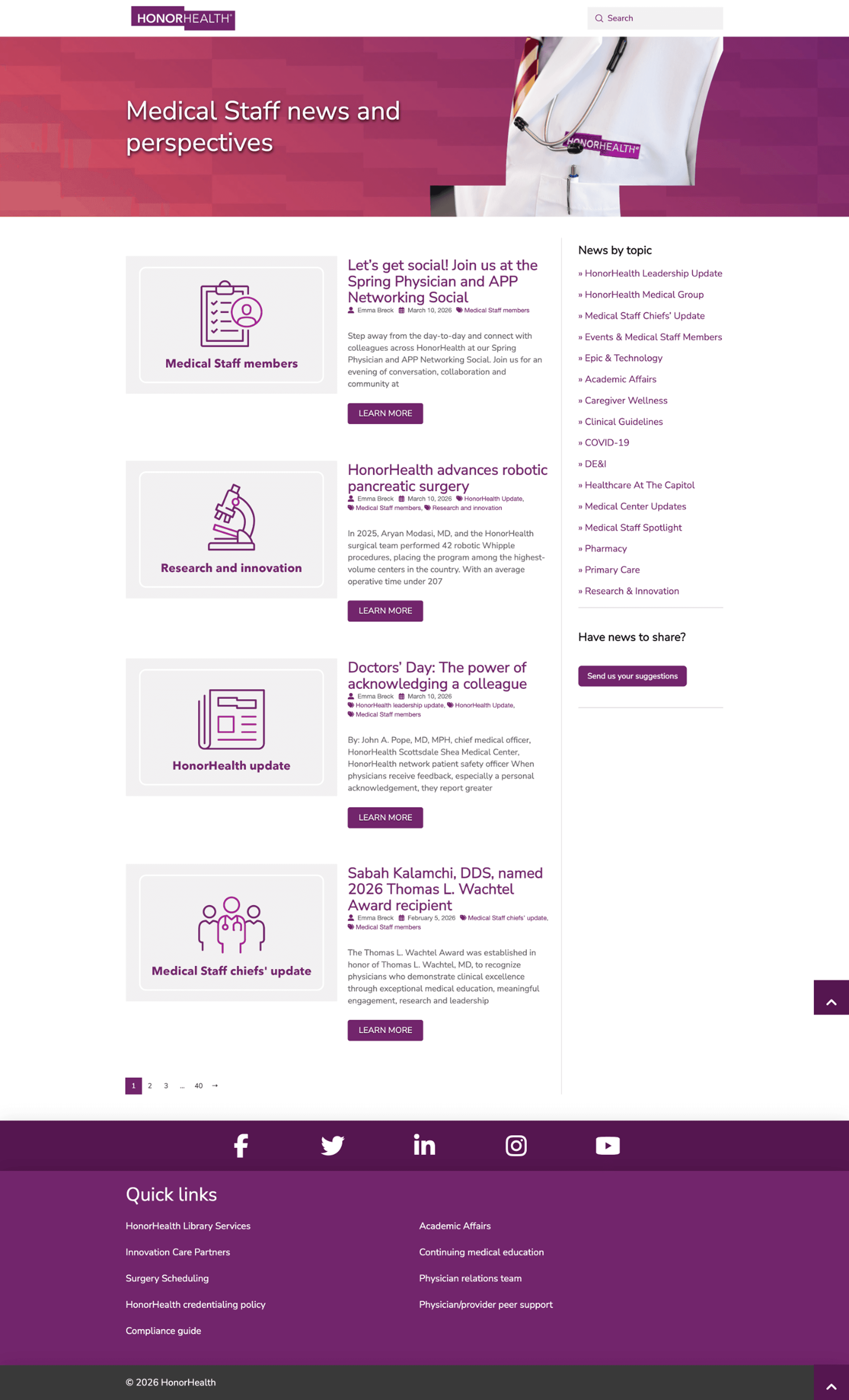
When physician and APP communications transferred to Marketing, we were starting from zero. The existing site, honorhealthphysicians.com, was an outdated newsletter archive that excluded APPs in its name. Most providers didn't know it existed, and those who did found it unusable.
Despite strong email performance, information was scattered across disconnected platforms: email, SharePoint, Epic, newsletters, and word-of-mouth.
Physicians were reading emails but couldn't "re-find" content when action was required. This was also a business risk: wasted effort creating "disposable" content and the absence of a central directory led to referral leakage.
didn't know where to find information
said info was spread across too many channels
of contracted providers felt out of the loop.
of open-ended comments flagged lack of central hub
The question
Solution
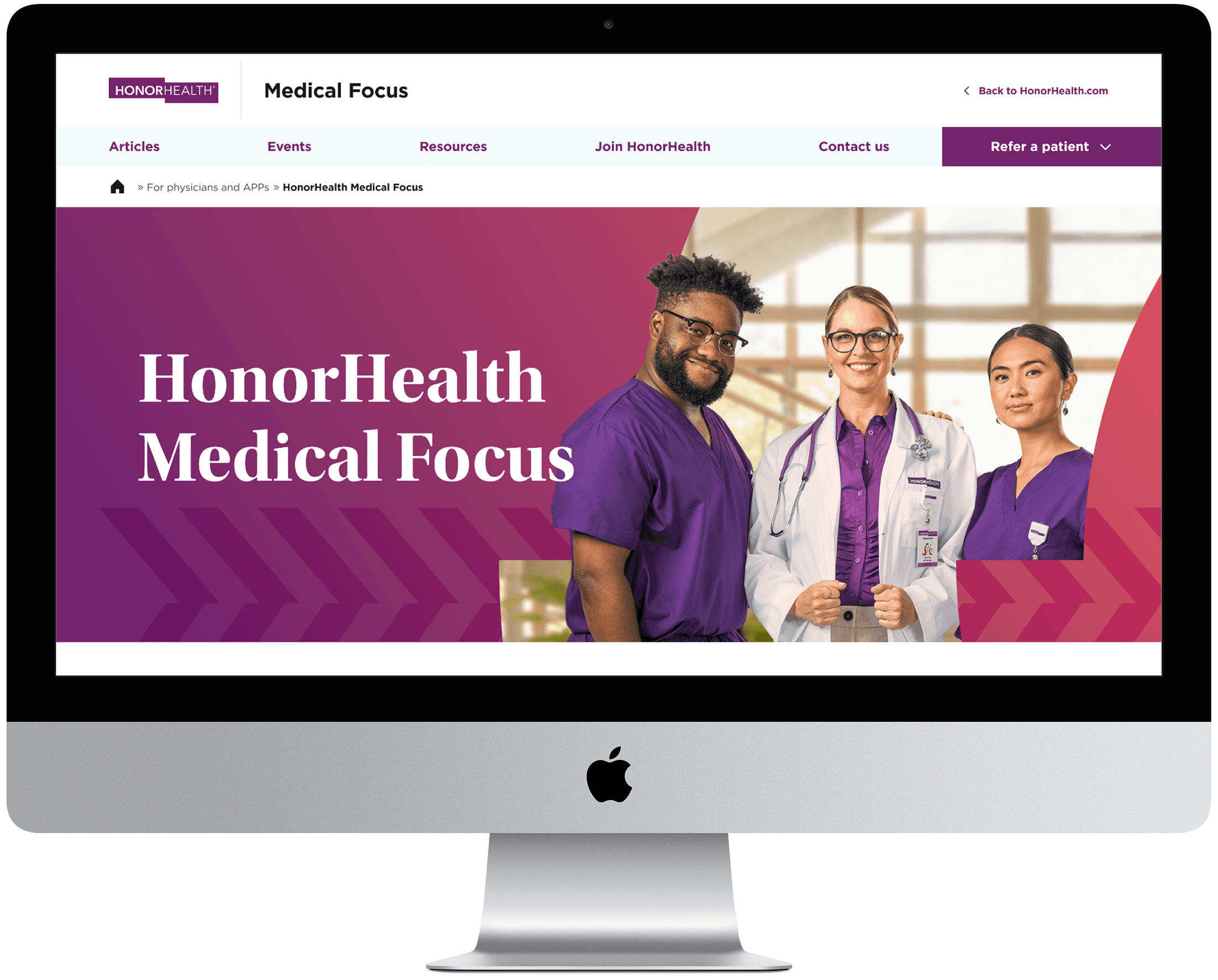
A task-focused site that helps providers find what they need quickly, organized around how providers think, not how the organization is structured. Using a site-within-a-site approach on HonorHealth.com, the experience is fully separated for providers while still leveraging the parent site infrastructure.
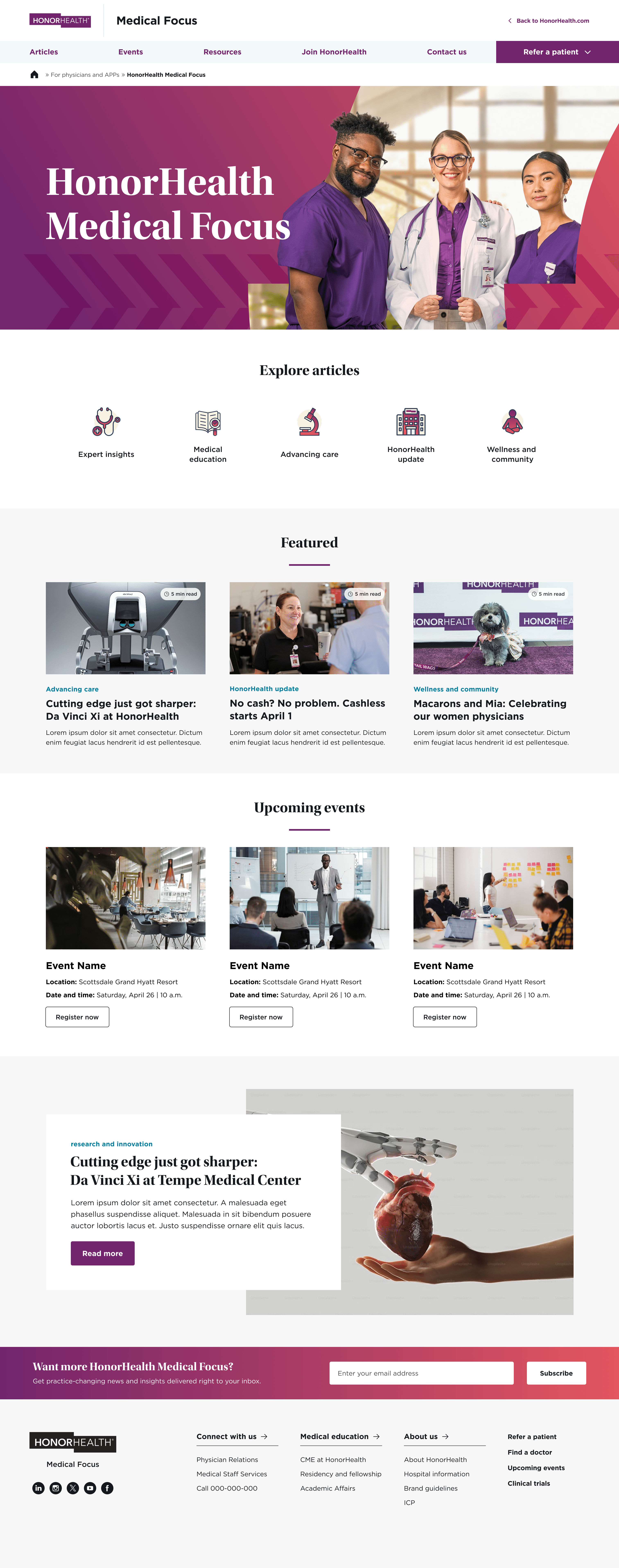
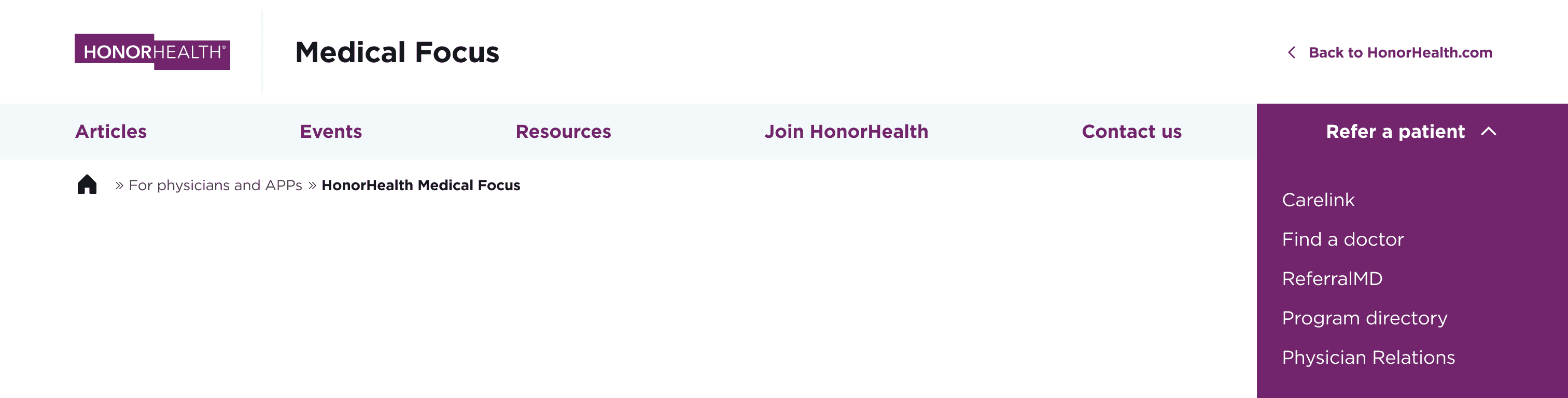
Top nav with Articles, Events, Resources, Join HonorHealth, and Contact Us. A distinct Refer a Patient item with a functional dropdown.
15 legacy categories replaced with five below the hero for quick discovery.
Site-within-a-site framework
Decoupled UI on HonorHealth.com that fully separates provider content from the public site.
Cloaked navigation removes parent headers and footers once providers enter Medical Focus.
Accessibility and scannability
Fixed heading issues that previously discouraged H2/H3 use and alt text.
WCAG Level AAA compliant.
Read Time tags and a grid-based visual hierarchy to reduce cognitive load.
HOW I GOT THERE
Before formal research was approved, I built strategy using observation and existing data: shadowing providers, auditing all communication channels, analyzing engagement data, and partnering with Medical Staff Services and Physician Relations to understand audience segments by credentialing status and employment model.
This early work surfaced something huge: the problem wasn't volume, it was organization.
Providers could read information, but couldn't reliably re-find it when they needed it.
01
Shadowed providers, pulled engagement data, and audited all channels. Defined audience segments and built an initial content taxonomy before formal approval.
02
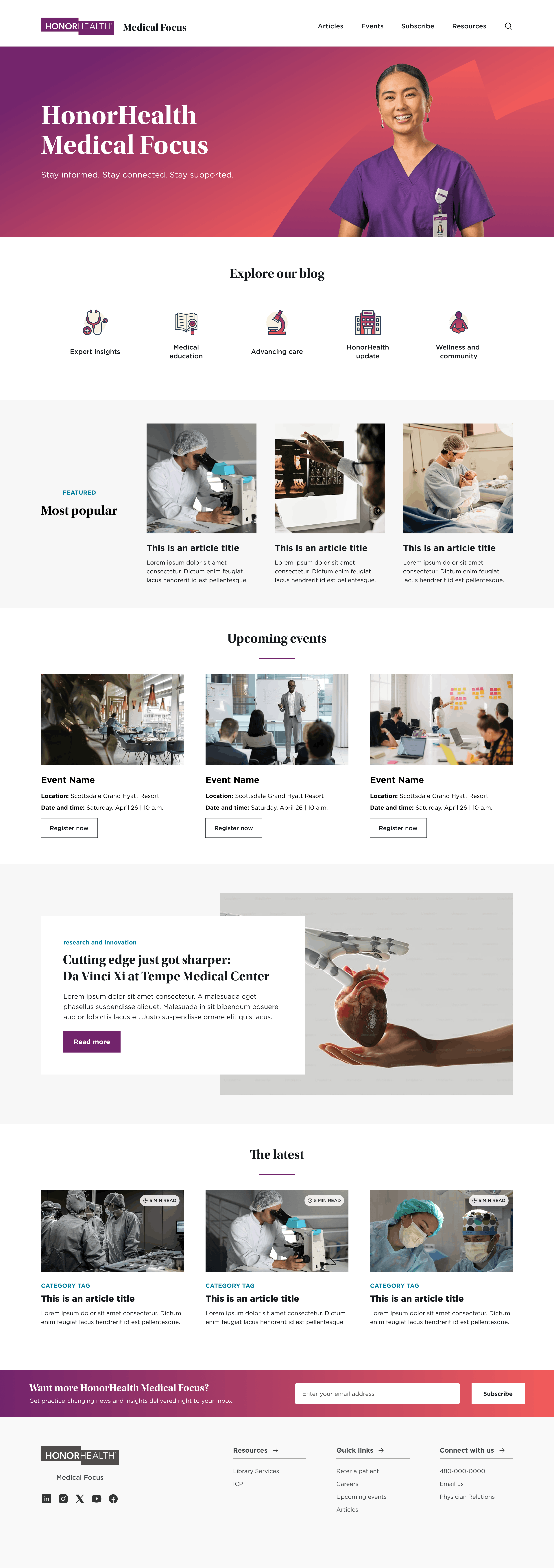
Replaced the brochure-style layout with a task-based structure. Reduced 15 legacy categories to five content pillars aligned with provider needs.
Executive leadership responded enthusiastically, unlocking formal research.
Led with a massive, non-functional hero image
Actionable content buried below the fold and hidden in blog articles
Navigation reflected internal structure, not provider mental models
15 content categories that didn't align with content pillars
No audience segmentation, no path for external providers
Task-based structure with five content pillar categories
Featured section to give users a clear starting point
Multi-column grid to cut scroll fatigue
High-quality photography for a human-centric feel
Events and Resources with dedicated pages
03
Designed and ran a full quantitative and qualitative study with credentialed physicians and APPs across HonorHealth.
Insight #1: The re-finding gap
Email is the dominant and preferred channel. 68% of providers use it, 71% prefer it. But 60% read less than half of what they receive, and 30% report never receiving information at all.
Design implication: Content needs to be discoverable on demand, not just in the moment it's sent.
Insight #2: Communication overload was real… but a targeting problem
Providers described feeling "inundated" and "bombarded." But only 18% of employed physicians said they received too much communication, compared to 9% of contracted providers.
Design implication: The problem was relevance, not volume. Better targeting, not less content.
Insight #3: The contracted provider blind spot
73% of contracted providers said they felt out of the loop. Our channel audit confirmed why: most communications only reached credentialed providers. Contracted groups like ER physicians, hospitalists, and anesthesiologists had few reliable touchpoints beyond email.
Design implication: The site needed to serve contracted providers, not just employed staff.
Insight #4: Providers want a hub, not another app
Both the survey and interviews confirmed providers want a centralized place for information.
Design implication: They do not want another portal, another app, another thing to check. The solution had to live somewhere they could actually find.
04
Before the second iteration, I ran a closed card sort to test the proposed site structure from iteration one.
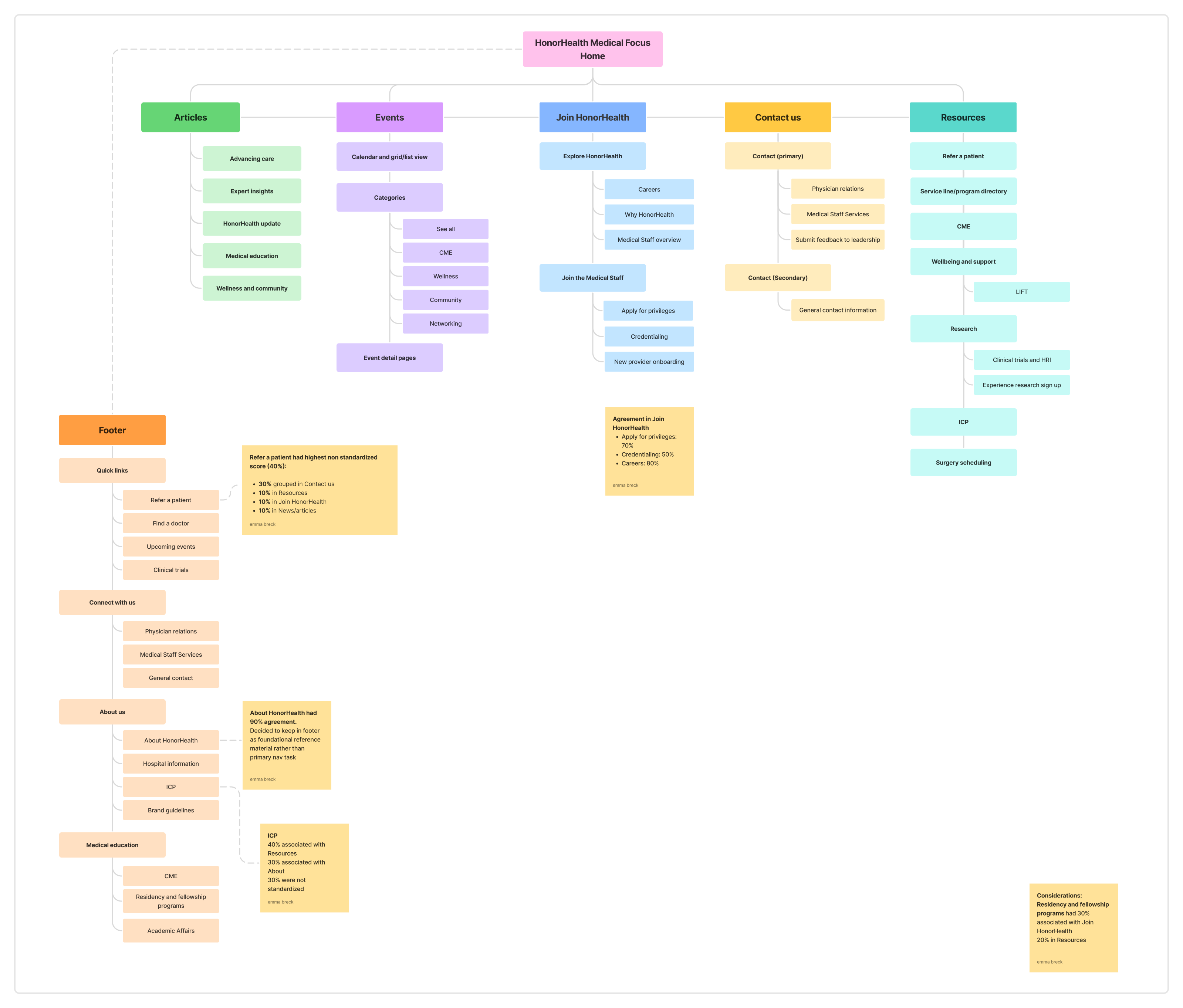
The structure aligned strongly with provider mental models so no major IA overhaul was needed. Key adjustments: Join HonorHealth and Contact Us moved to top navigation. Refer a Patient became a primary top-level item with a dropdown for all referral pathways.

The IA we landed on
05
Strategic pivot to a decoupled UI on HonorHealth.com. Raised concerns around content overlap, search visibility, and experience integrity, which directly shaped the final solution. Now in design and preparing for development handoff (Q2 launch).
Top nav – CTA item closed

Top nav – CTA item open
CHALLENGES AND SOLUTIONS
IMPACT
What this taught me