Watchbuddy
Watchbuddy
PROJECT OVERVIEW
TL;DR
TL;DR
TL;DR
Streaming fatigue is real.
With so many streaming platforms and endless content choices, finding something to watch has become harder than actually watching it.
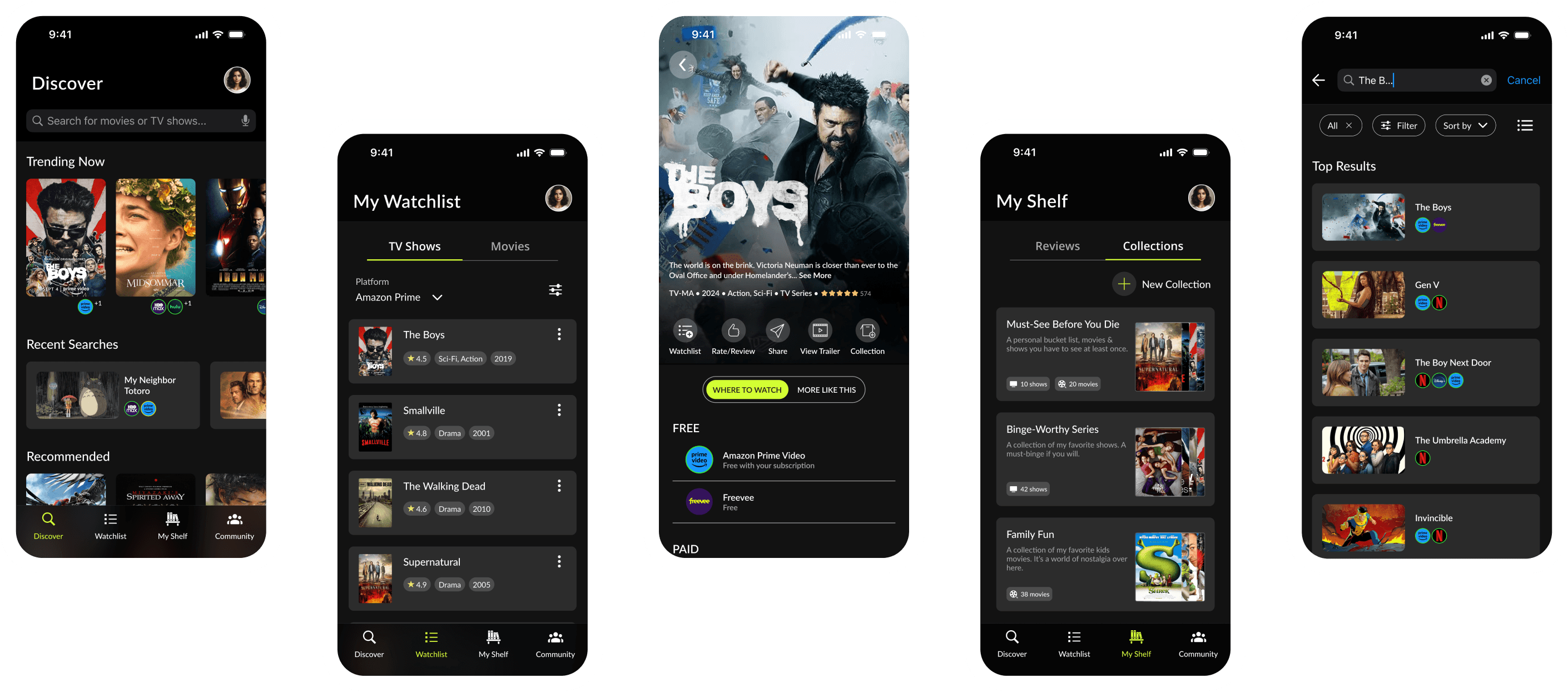
I designed WatchBuddy, a unified app with color-coded availability indicators that instantly show users what they can watch right now across all their platforms.
Role
Product designer / Solo project
Timeline
12 weeks
PROBLEM
Too much content, not enough time
Too much content, not enough time
Too much content, not enough time
Between Netflix, Hulu, Disney+, and HBO Max, users spend more time searching than watching.
This cluttered, repetitive experience turns what should be effortless downtime into frustrating, time-consuming decision fatigue.
4
streaming subscriptions
per user
streaming subscriptions
per user
streaming subscriptions
per user
(Deloitte, 2025)
46%
feel overwhelmed by
content choices
feel overwhelmed by
content choices
feel overwhelmed by
content choices
(Nielsen, 2022)
18
minutes wasted daily
deciding what to watch
minutes wasted daily
deciding what to watch
minutes wasted daily
deciding what to watch
(Fortune, 2024)
(Fortune, 2024)
Biggest pain point
Biggest pain point
Remembering where a specific show lives
Remembering where a specific show lives
The question
The question
How might we simplify content discovery across multiple platforms so users spend less time searching and more time watching?
How might we simplify content discovery across multiple platforms so users spend less time searching and more time watching?
solution
Meet WatchBuddy
Meet WatchBuddy
Meet WatchBuddy
1
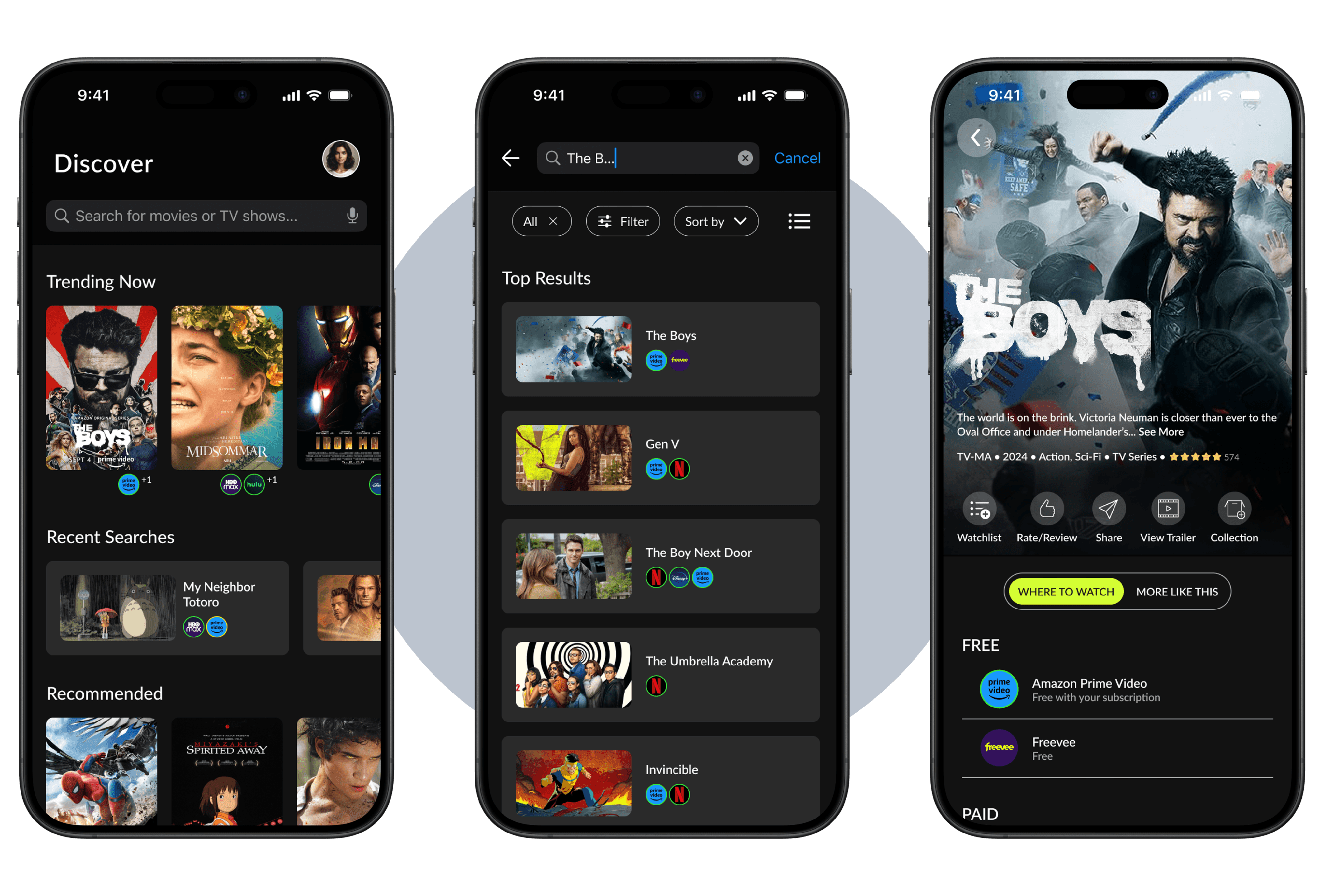
Universal search with smart availability platform indicators
Platform availability indicators
Users search once to see instant availability across all platforms.
Color-coded badges instantly communicate status: green (free on your subscription), yellow (rent/buy), or no outline (platform not subscribed).
This eliminates the cognitive load of constantly asking "Where is it?" and "Do I have access?"
Users search once to see instant availability across all platforms.
Color-coded badges instantly communicate status: green (free on your subscription), yellow (rent/buy), or no outline (platform not subscribed).
This eliminates the cognitive load of constantly asking "Where is it?" and "Do I have access?"
2
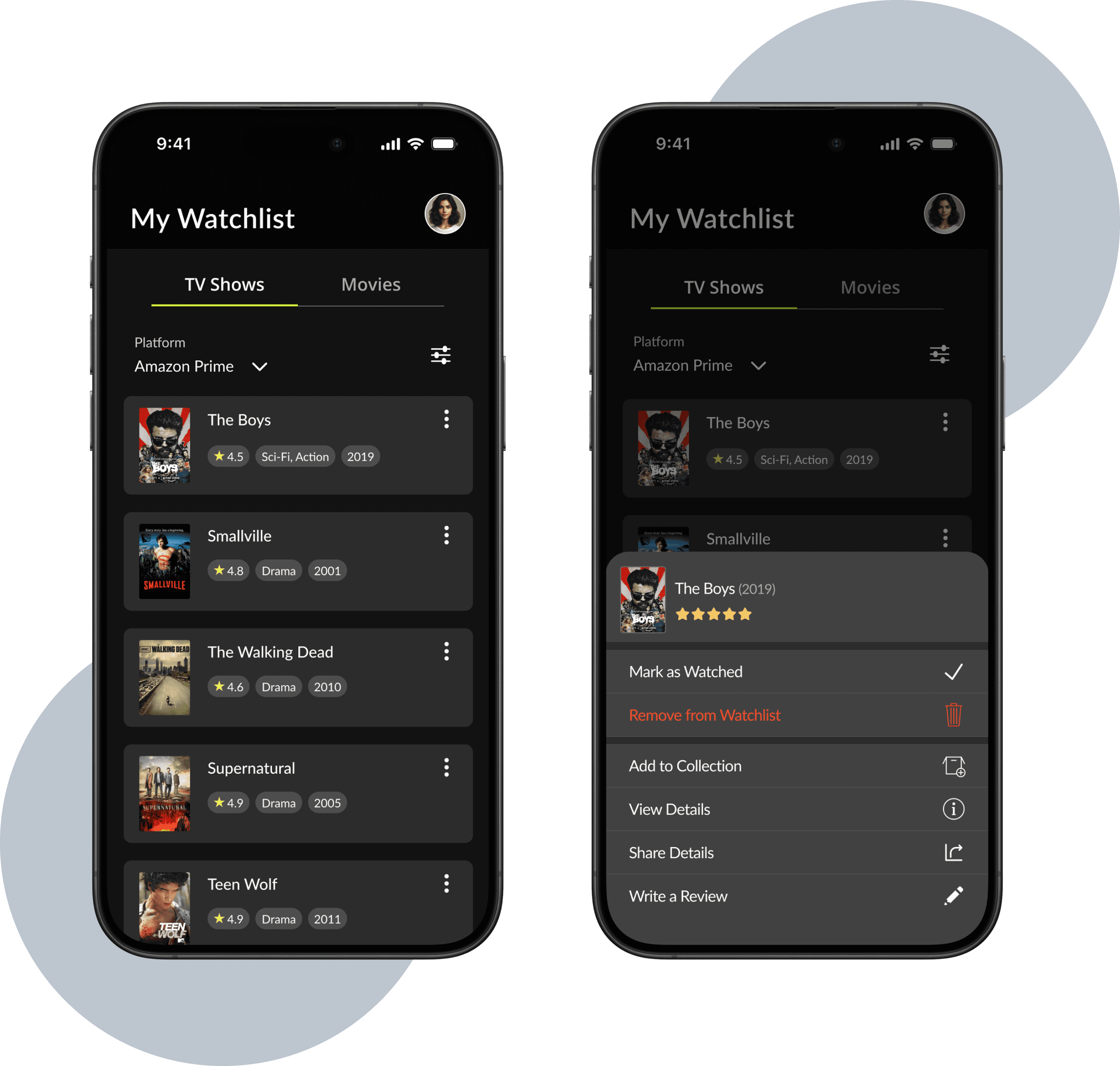
Smart watchlist management
The watchlist features platform filtering and separates Movies and TV shows into tabs, transforming a messy task list into an efficient viewing pipeline.
The watchlist features platform filtering and separates Movies and TV shows into tabs, transforming a messy task list into an efficient viewing pipeline.
3
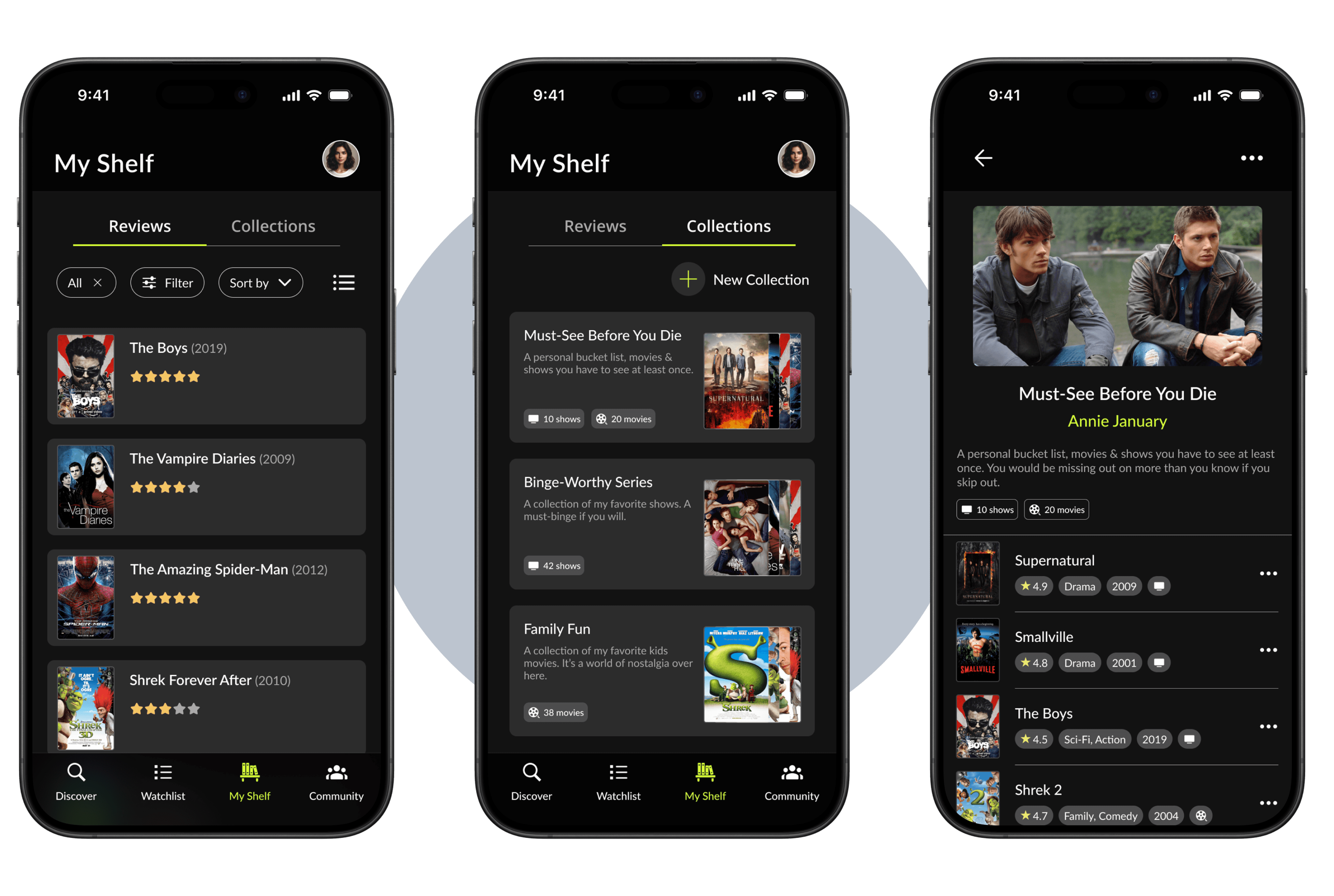
Personalized expression
“My Shelf" allows users to share reviews and create collections.
Collections function like playlists, with custom descriptions and visual previews, accelerating adoption through familiar mental models.
4
Community
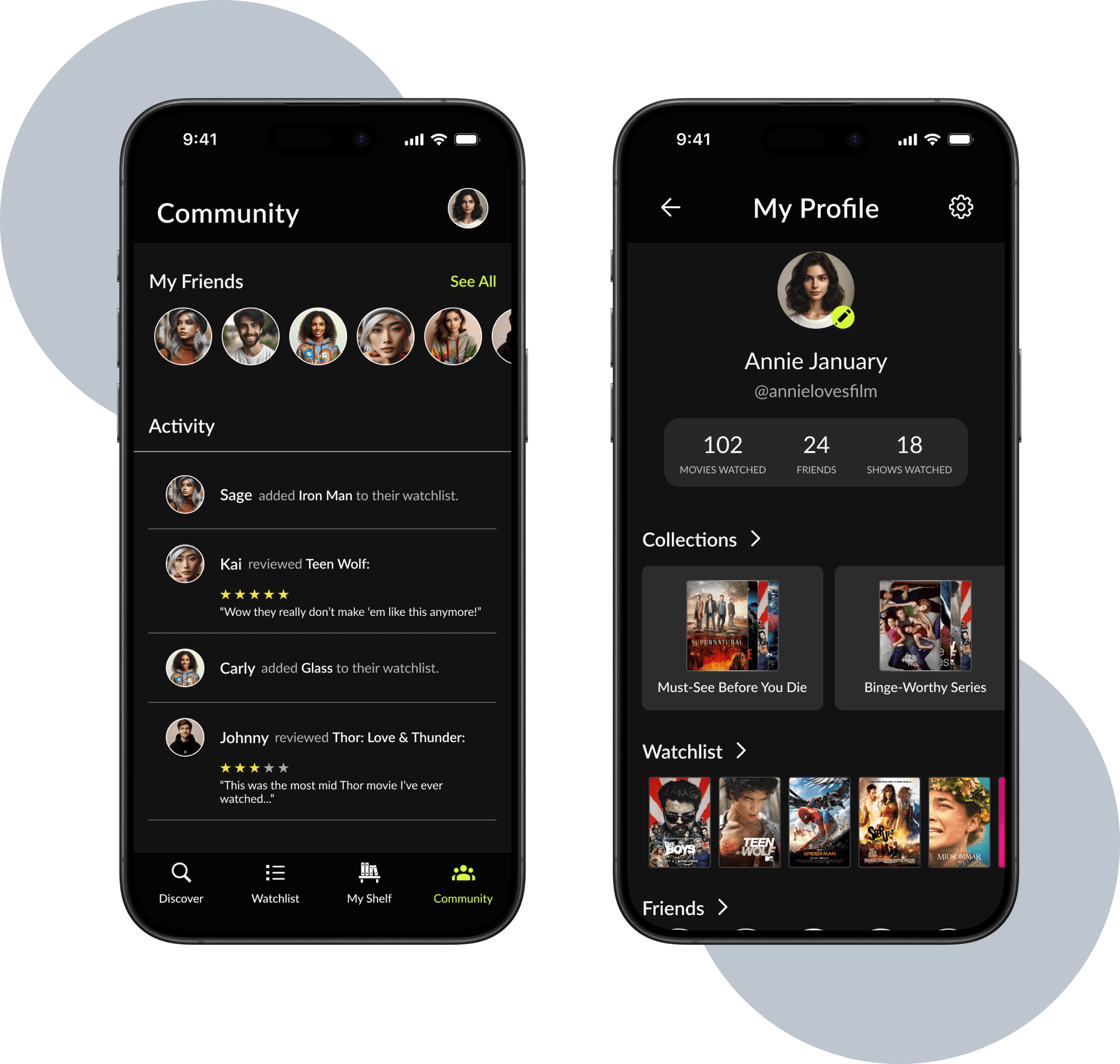
Community shows real-time friend activity: watchlist adds, reviews, and ratings.
Users can explore friend profiles, collections, and reviews, leveraging the most powerful recommendation engine: friends.
HOW I GOT THERE
User research
User research
I interviewed 8 frequent streamers and surveyed 42 others to understand their viewing habits.
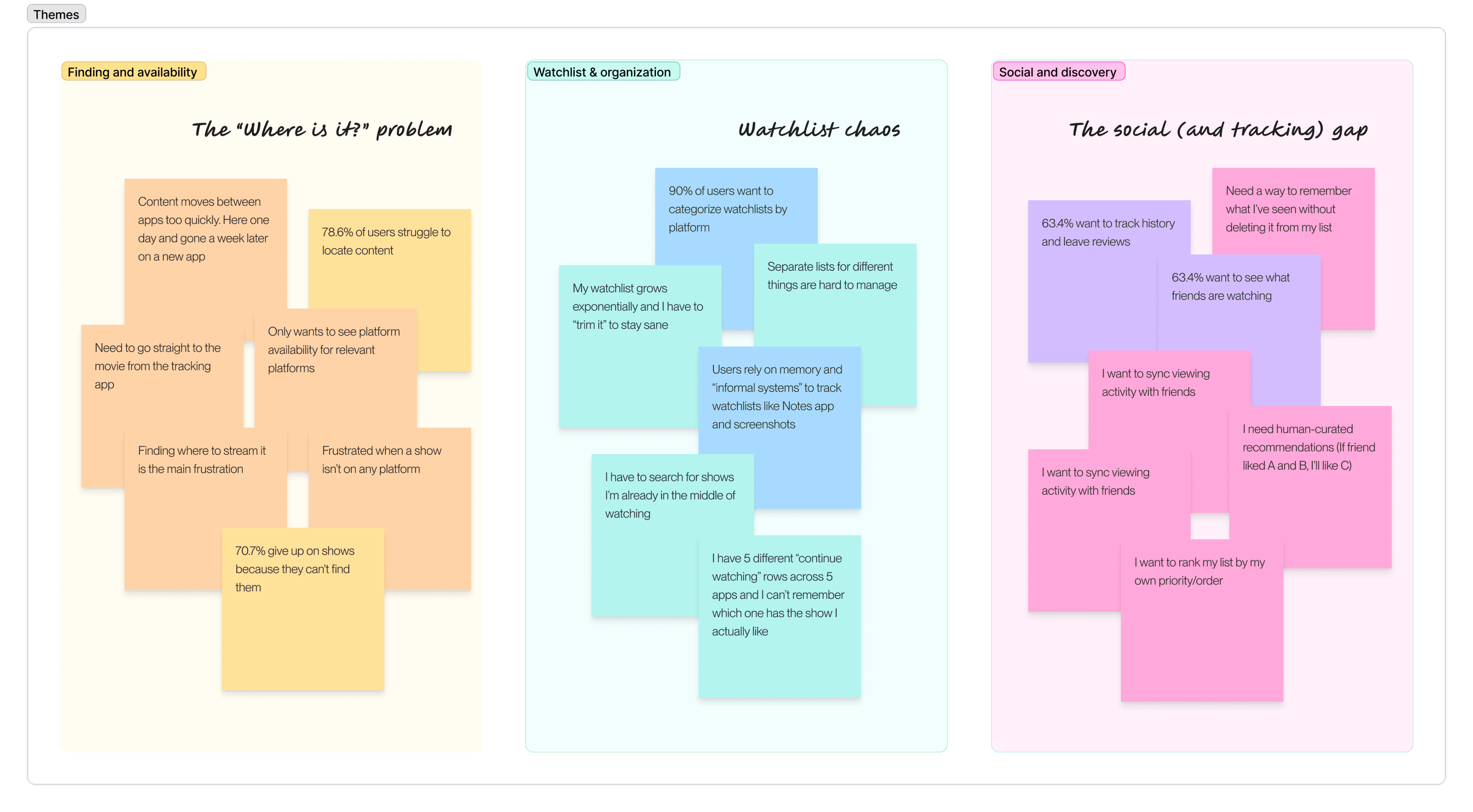
Through an affinity diagramming exercise, I reviewed user data, organized, and summarized key points. Three insights came up:
Insight #1: The "Where Is It?" problem
Insight #1: The "Where Is It?" problem
78.6% of users struggle to locate content, leading to 70.7% giving up on shows they wanted to watch.
Design Implication: Centralized search that immediately shows content location and user's current subscription access.
78.6% of users struggle to locate content, leading to 70.7% giving up on shows they wanted to watch.
Design Implication: Centralized search that immediately shows content location and user's current subscription access.
Insight #2: Watchlist chaos
Insight #2: Watchlist chaos
Users relied on screenshots, notes, and mental bookmarks. 90% found watchlist categorization by platform valuable.
Design Implication: A content management system that allows users to easily add, sort, and filter content by platform.
Users relied on screenshots, notes apps, and mental bookmarks. 90% of users found watchlist categorization by platform valuable.
Design Implication: A content management system that allows users to easily add, sort, and filter content by platform.
Insight #3: The social (& tracking) gap
Insight #3: The social (& tracking) gap
Users want to track watched content, leave reviews, and share recommendations (63.4%). Existing tools force texting.
Design Implication: Native social and tracking features for managing viewing history and sharing recommendations.
Users want to track watched content, leave reviews, and share recommendations (63.4%). Existing tools force texting.
Design Implication: Native social and tracking features for managing viewing history and sharing recommendations.
HOW I GOT THERE
Determining WatchBuddy's value prop
Determining WatchBuddy's value prop
Determining WatchBuddy's value prop




I analyzed JustWatch, Reelgood, TV Time, and IMDb.
While they offer cross-platform search, they provide raw data, not instant decision-making.
This defined WatchBuddy’s unique opportunity: a color-coded "Availability Engine" that instantly identifies if a title is free-to-watch, for-rent, or unavailable within a user's specific subscription stack. We move users from "Where is this streaming?" to "I can watch this now" in a single glance, backed by superior watchlist management.
I analyzed JustWatch, Reelgood, TV Time, and IMDb. While they offer cross-platform search, they provide raw data, not instant decision-making.
This defined WatchBuddy’s unique opportunity: a color-coded "Availability Engine" that instantly identifies if a title is free-to-watch, for-rent, or unavailable within a user's specific subscription stack. We move users from "Where is this streaming?" to "I can watch this now" in a single glance, backed by superior watchlist management.
HOW I GOT THERE
The foundational work
The foundational work
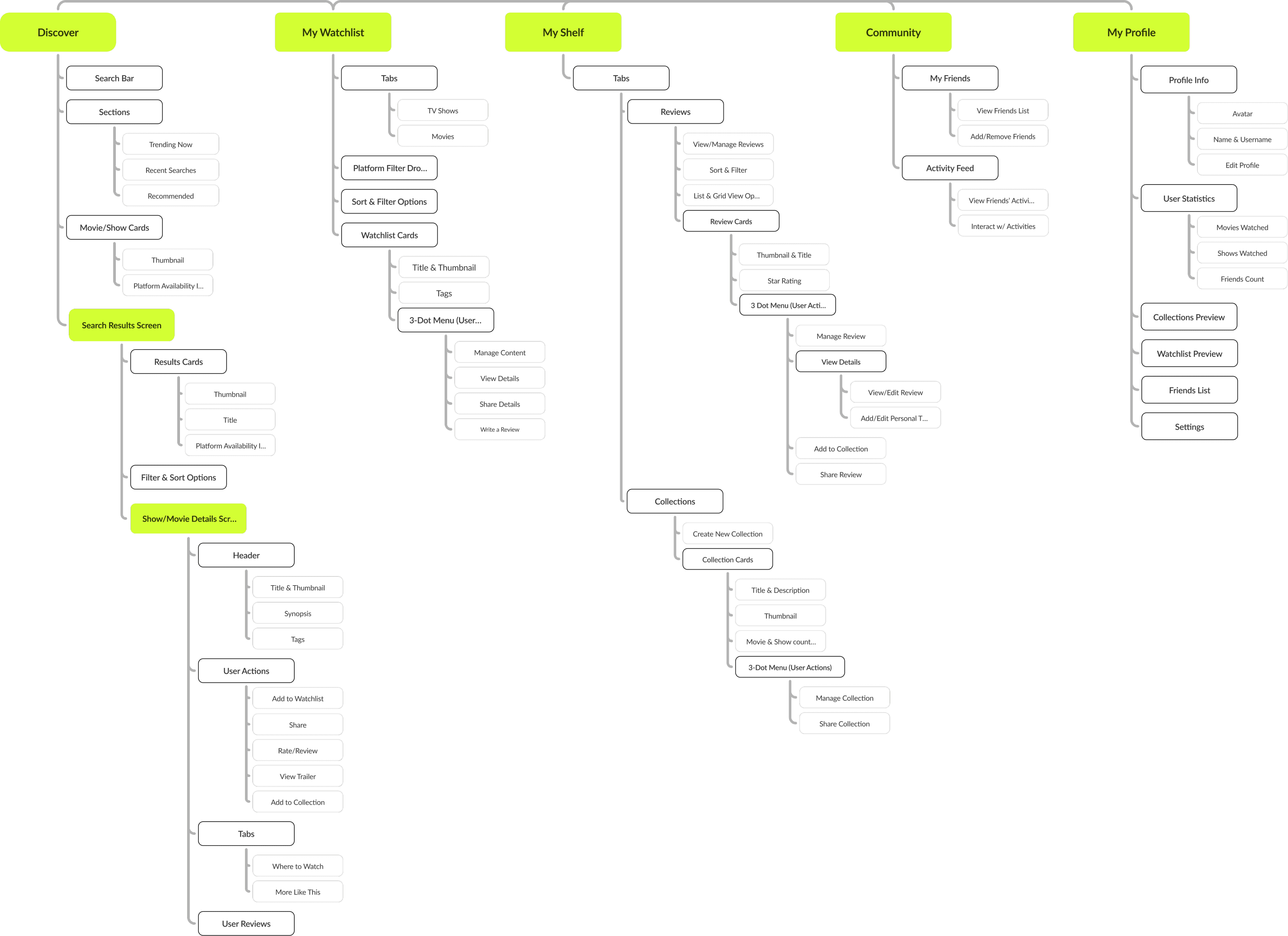
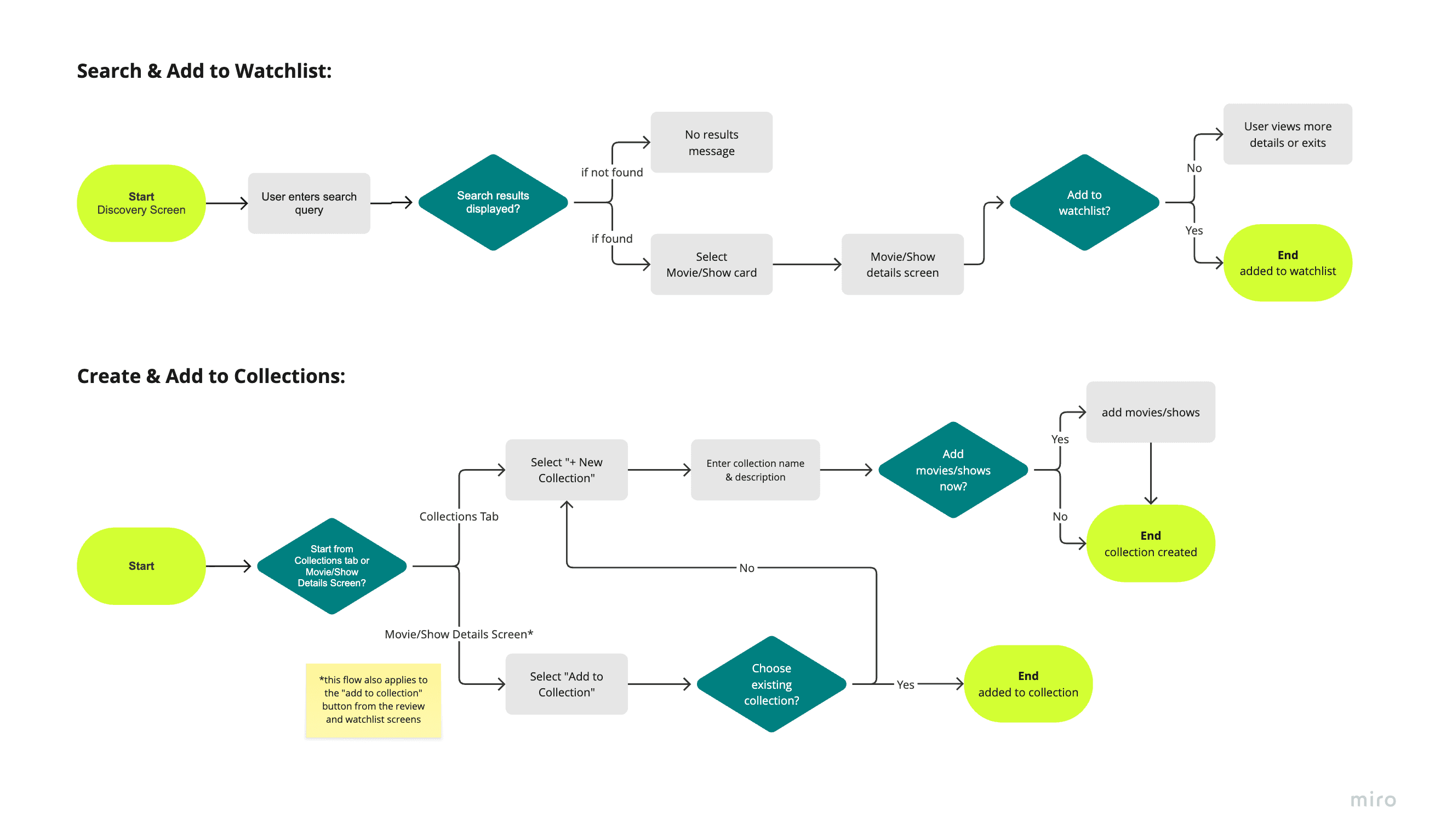
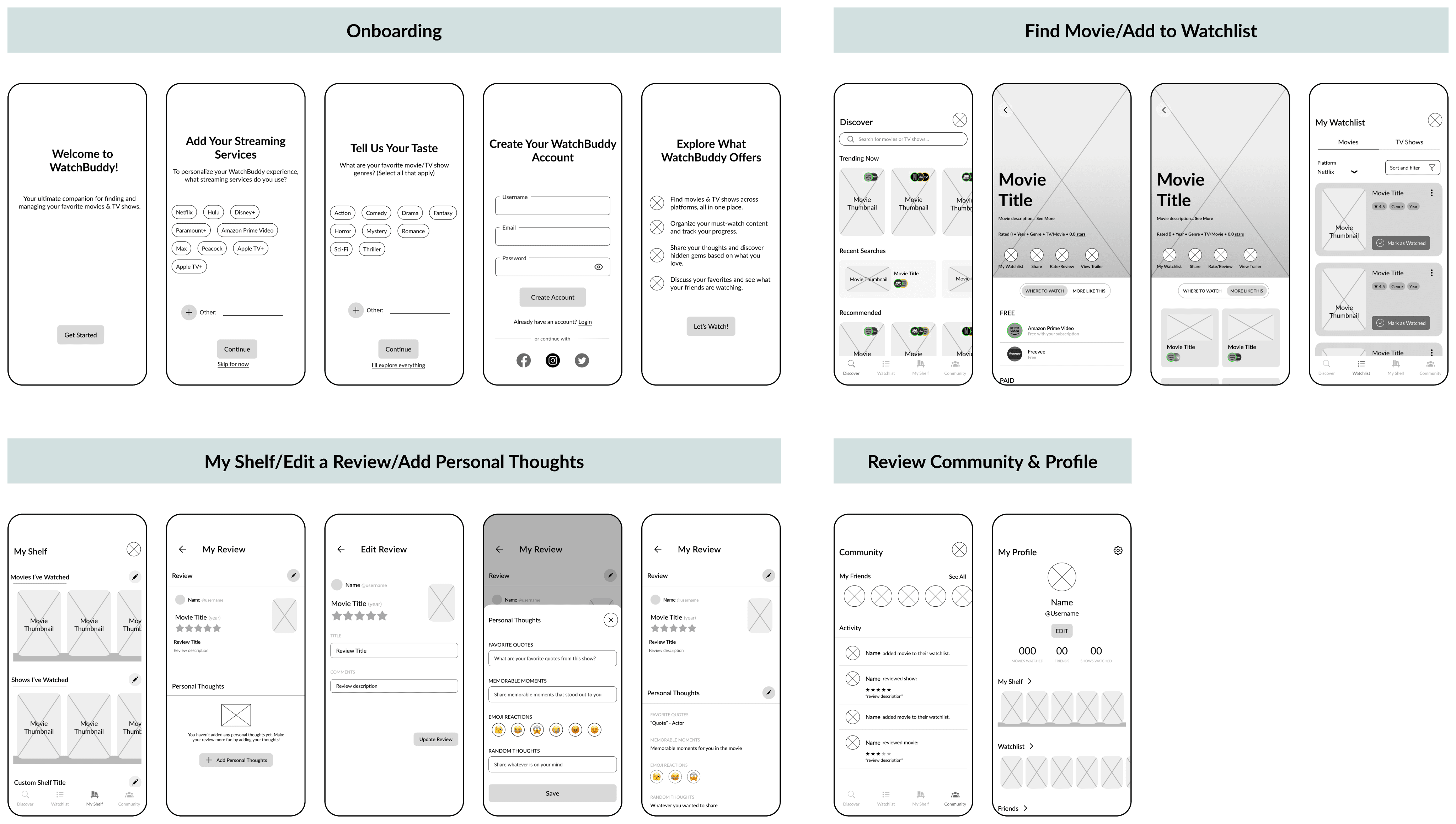
After seeing what was already out there and identifying user needs and frustrations, I translated the solution into a structural blueprint.
I mapped out the information architecture, key user flows, and wireframes to make sure that the journey (from discovering a show to seeing its availability, and adding it to the watchlist) was as easy as possible.
Usability testing
How usability testing impacted the design
How usability testing impacted the design
How usability testing impacted the design
I conducted usability testing with six participants, testing four key flows: Onboarding, finding a moving and adding it to watchlist, navigating “My Shelf” (including editing a review and adding personal thoughts), and interacting with community and their profile.
This made it obvious what improvements my initial design needed.
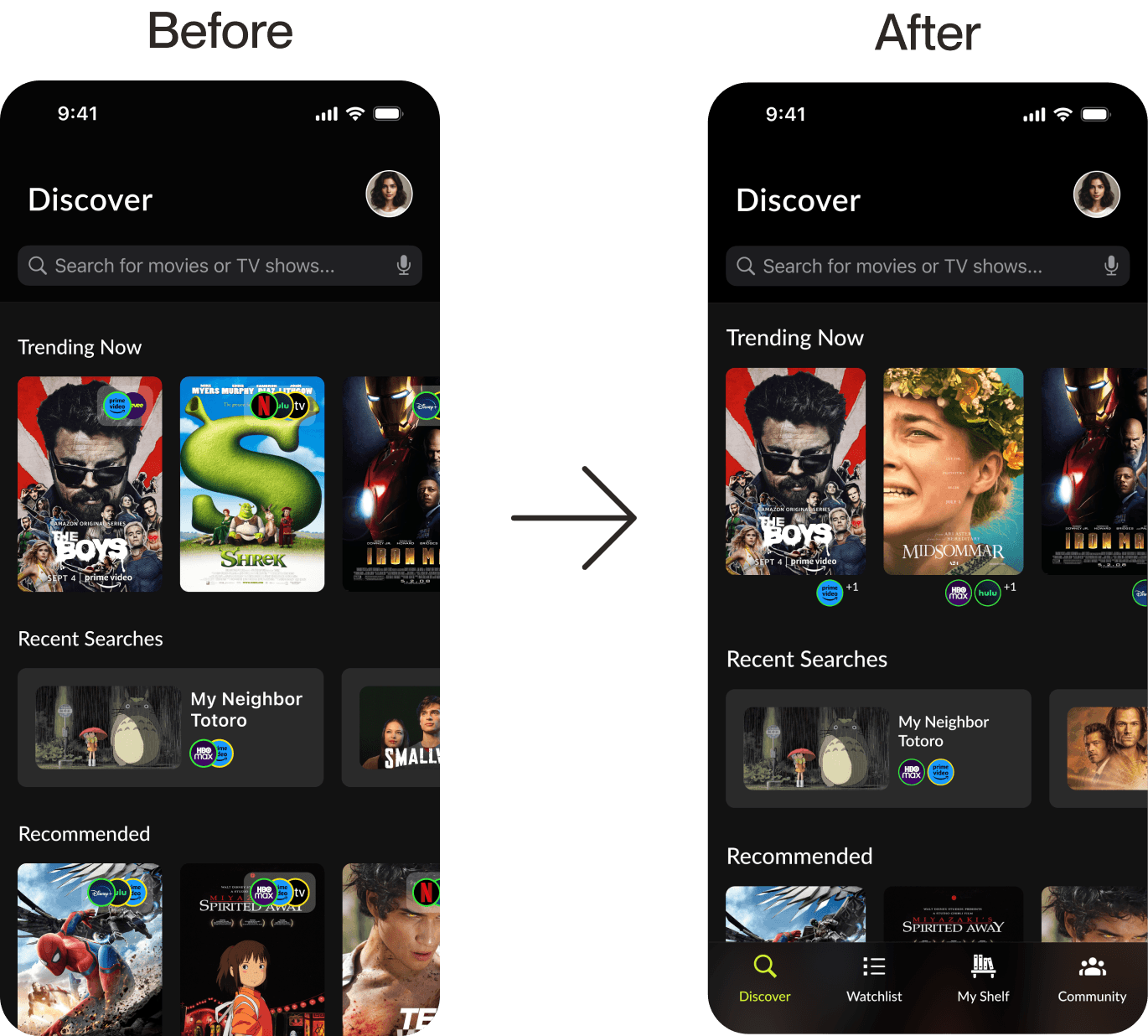
1 - Smarter availability indicators
1 - Smarter availability indicators
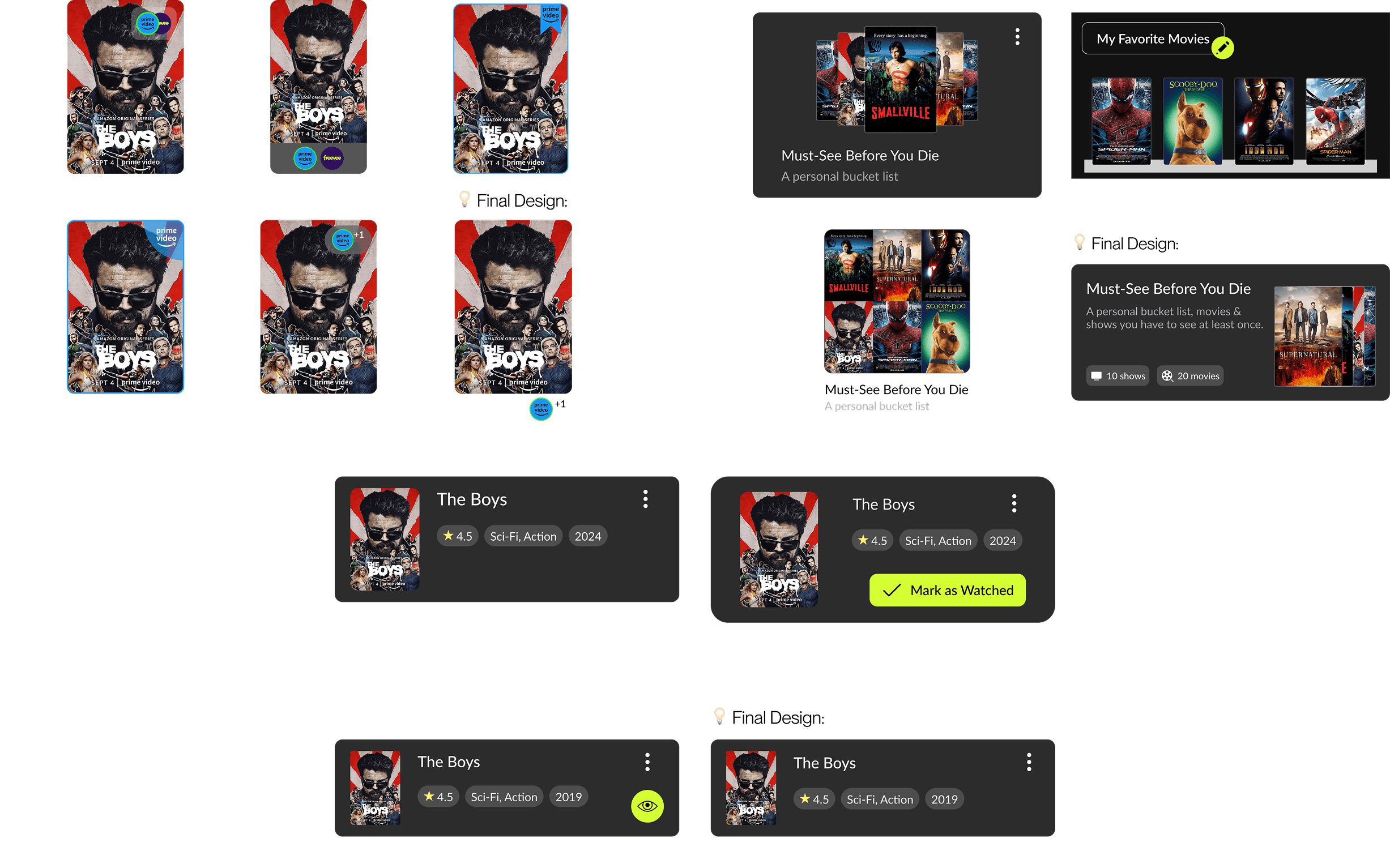
Problem: The Discover page was overwhelming and showed too many platform badges regardless of subscription status.
Solution: Only showed platforms relevant to the user’s subscription status. Added a green outline (free on a user's service), with a "+1" indicator simplifying multi-platform availability.
Feedback: "I love the green outline! It's great to be able to see what I can watch right now without looking more."
Problem: The Discover page was overwhelming and showed too many platform badges regardless of subscription status.
Solution: Only showed platforms relevant to the user’s subscription status. Added a green outline (free on a user's service), with a "+1" indicator simplifying multi-platform availability.
Feedback: "I love the green outline! It's great to be able to see what I can watch right now without looking more."
2 - "My Shelf" separation
2 - "My Shelf" separation
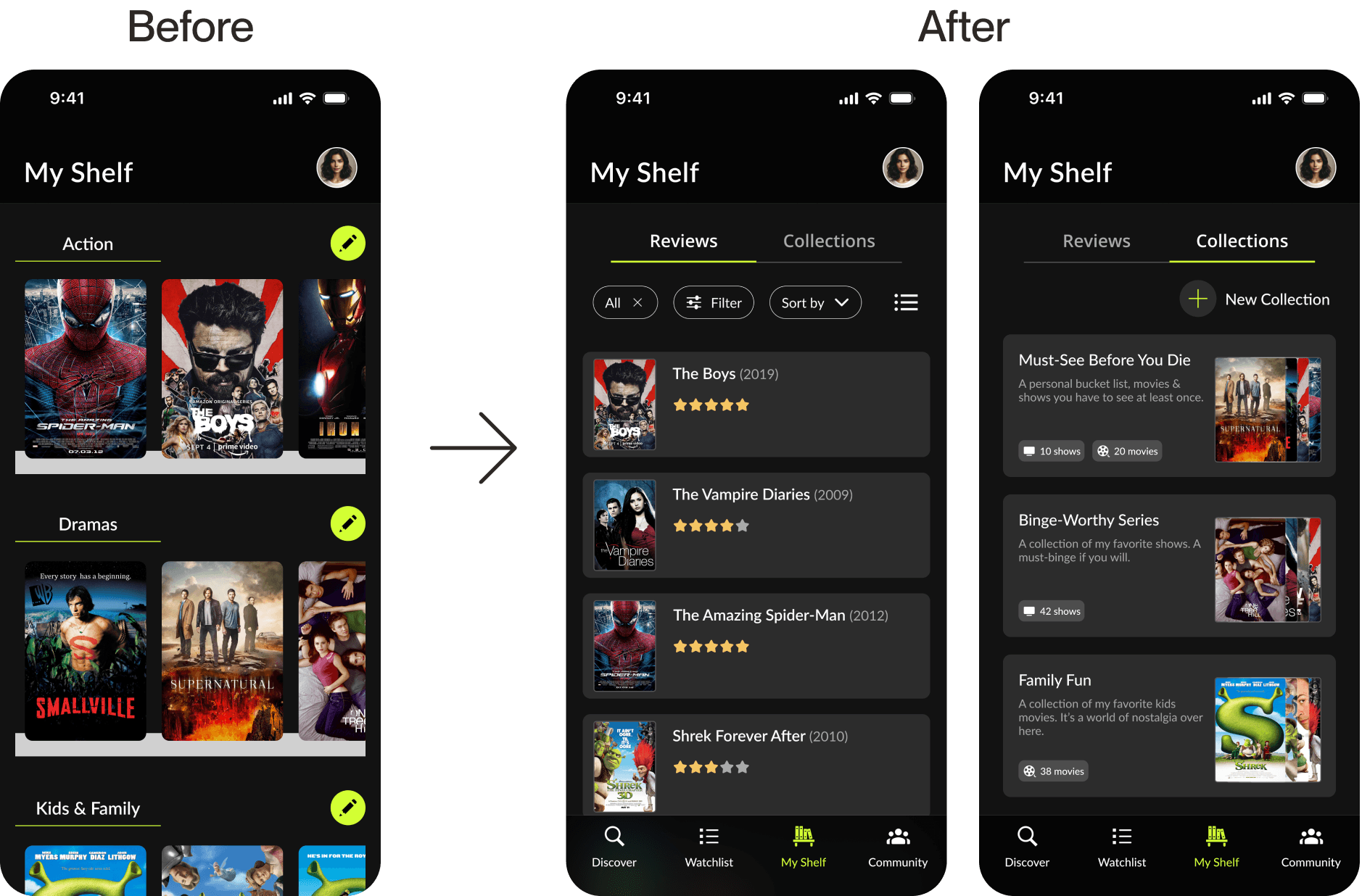
Problem: Mixing Reviews and Collections confused users about the feature's dual purpose.
Solution: Split "My Shelf" into two dedicated tabs: Reviews and Collections, creating clear a clear difference between organization vs. sharing opinions.
Problem: Mixing Reviews and Collections confused users about the feature's dual purpose.
Solution: Split "My Shelf" into two dedicated tabs: Reviews and Collections, creating clear a clear difference between organization vs. sharing opinions.
3 - Simplified watchlist cards
3 - Simplified watchlist cards
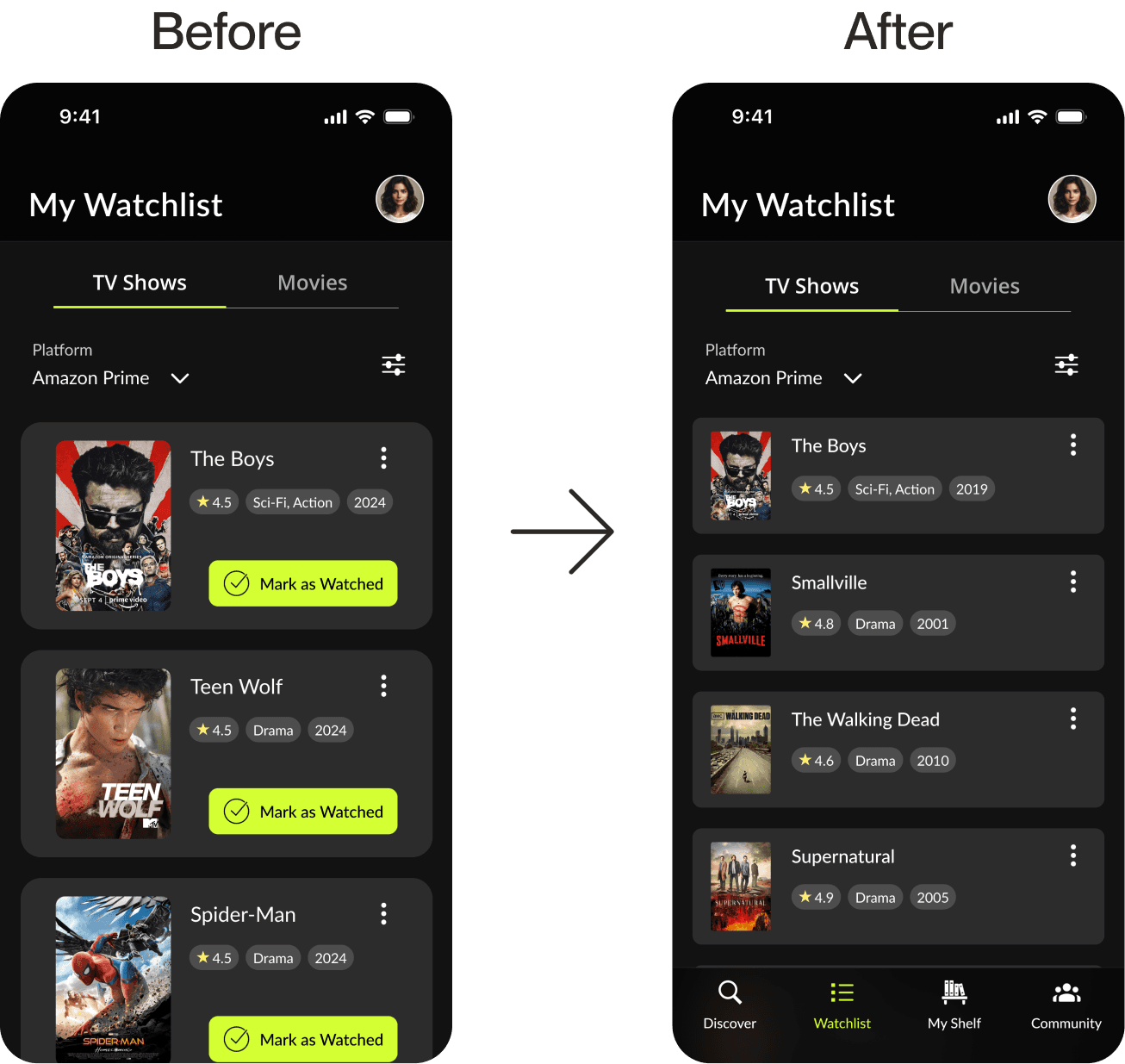
Problem: The "Mark as Watched" buttons cluttered the card’s surface and made lists hard to scan.
Solution: Removed action buttons from the card, leaving only essential information (poster, title, rating). Moved actions to a three-dot menu.
Feedback: "The buttons were super bright... they made me overwhelmed."
Problem: The "Mark as Watched" buttons cluttered the card’s surface and made lists hard to scan.
Solution: Removed action buttons from the card, leaving only essential information (poster, title, rating). Moved actions to a three-dot menu.
Feedback: "The buttons were super bright... they made me overwhelmed."
Card iterations
Card iterations
While these highlights show the major shifts, the final design is the result of a lot of micro-iterations.
While these highlights show the major shifts, the final design is the result of a lot of micro-iterations.
CHALLENGES AND SOLUTIONS
Hurdles I jumped
Hurdles I jumped
Hurdles I jumped
Balancing onboarding friction vs. personalization value
Solution: Inverted the conventional onboarding flow (prioritizing Platform Selection before Account Creation). This focus on immediate Time-to-Value (TTV) was validated by a 50 percentage point increase in completion (from 33.3% to 83.3%).
Avoiding feature overload
Solution: Prioritized ruthlessly using a "Does this serve the core job?" lens to keep the Minimum Viable Product (MVP) focused.
Making social features feel natural, not forced
Solution: Designed the social feed and circular friend avatars to look like familiar apps (Instagram, Twitter) and incorporated gamification into profiles. This made the social layer easy to adopt and seamlessly enhanced content discovery.
Balancing onboarding friction vs. personalization value
Solution: Inverted the conventional onboarding flow (prioritizing Platform Selection before Account Creation). This focus on immediate Time-to-Value (TTV) was validated by a 50 percentage point increase in completion (from 33.3% to 83.3%).
Avoiding feature overload
Solution: Prioritized ruthlessly using a "Does this serve the core job?" lens to keep the Minimum Viable Product (MVP) focused.
Making social features feel natural, not forced
Solution: Designed the social feed and circular friend avatars to look like familiar apps (Instagram, Twitter) and incorporated gamification into profiles. This made the social layer easy to adopt and seamlessly enhanced content discovery.
Balancing onboarding friction vs. personalization value
Solution: Inverted the conventional onboarding flow (prioritizing Platform Selection before Account Creation). This focus on immediate Time-to-Value (TTV) was validated by a 50 percentage point increase in completion (from 33.3% to 83.3%).
Avoiding feature overload
Solution: Prioritized ruthlessly using a "Does this serve the core job?" lens to keep the Minimum Viable Product (MVP) focused.
Making social features feel natural, not forced
Solution: Designed the social feed and circular friend avatars to look like familiar apps (Instagram, Twitter) and incorporated gamification into profiles. This made the social layer easy to adopt and seamlessly enhanced content discovery.
Validation and future vision
Validation and future vision
Validation and future vision
While WatchBuddy remains a concept project, the design showed promise:
83.3% of testers would use it regularly
Multiple participants asked, "Can I download this?"
Positive feedback on the visual design and interaction patterns
Next steps (if this wasn't a concept project):
Integrate API for live updates: Show the most recent platform changes for each movie or TV show
Watchlist alerts: Notify users when items become free or move to a subscribed platform
While WatchBuddy remains a concept project, the design showed promise:
83.3% of testers would use it regularly
Multiple participants asked, "Can I download this?"
Positive feedback on the visual design and interaction patterns
Next steps (if this wasn't a concept project):
Integrate API for live updates: Show the most recent platform changes for each movie or TV show
Watchlist alerts: Notify users when items become free or move to a subscribed platform
While WatchBuddy remains a concept project, the design showed promise:
83.3% of testers would use it regularly
Multiple participants asked, "Can I download this?"
Positive feedback on the visual design and interaction patterns
Next steps (if this wasn't a concept project):
Integrate API for live updates: Show the most recent platform changes for each movie or TV show
Watchlist alerts: Notify users when items become free or move to a subscribed platform
Reflections
Reflections
Reflections
Research is for reframing.
User research proved my initial ideas wrong, showing users valued organization tools over algorithm-heavy recommendations.
Small cues solve big problems.
A single color-coded badge eliminated multiple pain points and became the most noticed and appreciated feature.
Leverage mental models.
Structuring collections like familiar services (e.g., Apple Music playlists) reduced cognitive load and made the concept instantly understandable.
Iteration defines quality.
Two rounds of testing turned “My Shelf” from a confusing feature into the most-loved part of the app.
Research is for reframing. User research proved my initial ideas wrong, showing users valued organization tools over algorithm-heavy recommendations.
Small cues solve big problems. A single color-coded badge eliminated multiple pain points and became the most noticed and appreciated feature.
Leverage mental models. Structuring collections like familiar services (e.g., Apple Music playlists) reduced cognitive load and made the concept instantly understandable.
Iteration defines quality. Two rounds of testing turned “My Shelf” from a confusing feature into the most-loved part of the app.
Research is for reframing.
User research proved my initial ideas wrong, showing users valued organization tools over algorithm-heavy recommendations.
Small cues solve big problems.
A single color-coded badge eliminated multiple pain points and became the most noticed and appreciated feature.
Leverage mental models.
Structuring collections like familiar services (e.g., Apple Music playlists) reduced cognitive load and made the concept instantly understandable.
Iteration defines quality.
Two rounds of testing turned “My Shelf” from a confusing feature into the most-loved part of the app.
References
References
References
2025 Digital Media Trends: Social platforms are becoming a dominant force in media and entertainment. (2025, September 17). Deloitte Insights. https://www.deloitte.com/us/en/insights/industry/technology/digital-media-trends-consumption-habits-survey/2025.html
Quinn, W., & Quinn, W. (2022, July 21). Streaming is the future of TV, but the abundance of platform choice is overwhelming for viewers. Nielsen. https://www.nielsen.com/insights/2022/streaming-is-the-future-of-tv-but-abundance-of-platform-choice-is-overwhelming-for-viewers/
The Associated Press, Wealth of Geeks. (2024, December 24). You’re wasting 110 hours a year just scrolling for something to watch, study finds | Fortune. Fortune. https://fortune.com/2024/12/24/find-something-to-watch-netflix-youtube-hulu-peacock-hbo-max-streaming/
2025 Digital Media Trends: Social platforms are becoming a dominant force in media and entertainment. (2025, September 17). Deloitte Insights. https://www.deloitte.com/us/en/insights/industry/technology/digital-media-trends-consumption-habits-survey/2025.html
Quinn, W., & Quinn, W. (2022, July 21). Streaming is the future of TV, but the abundance of platform choice is overwhelming for viewers. Nielsen. https://www.nielsen.com/insights/2022/streaming-is-the-future-of-tv-but-abundance-of-platform-choice-is-overwhelming-for-viewers/
The Associated Press, Wealth of Geeks. (2024, December 24). You’re wasting 110 hours a year just scrolling for something to watch, study finds | Fortune. https://fortune.com/2024/12/24/find-something-to-watch-netflix-youtube-hulu-peacock-hbo-max-streaming/